
By Ryan Chia
30 Jun 2026
An Intern’s Reflection on the Use of Language in ArtsWok’s Communications
“Yeah, I thought it was pretty neat that that old guy was willing to share his life story like that.”
Or so I said, with a totally straight face at my first company meeting. I’d just been asked about my first official experience with one of ArtsWok’s workshops. To the Ryan of six months ago, “old guy” seemed a perfect descriptor for the man who’d spoken up about his experience with the tail end of the Japanese Occupation, coming to adulthood in post-colonial Singapore, and attending night school with his wife. He was, in fact, a guy (neutral), and he was, in fact, old (neutral).
I was gently corrected: the word we use is senior. At the time, I understood this as showing appropriate deference to my elders by using an appropriate term of address instead of casual shorthand. Fair enough.
It wouldn’t be until a bit later — when we began the process of compiling our own ArtsWok glossary, a guide to the language we use — that I really found myself plumbing the why of the correction. Working on the glossary made me sit down and articulate, in writing, what many key terms in our work actually meant to us, and why we’d chosen them.
That process of definition turned out to be the catalyst for this piece. Once you start asking the question: “Well, okay, why do we say things like this?”, it’s pretty much a foregone conclusion that the answers are almost never as simple as ‘because it’s polite’.
So, what are the answers I arrived at?
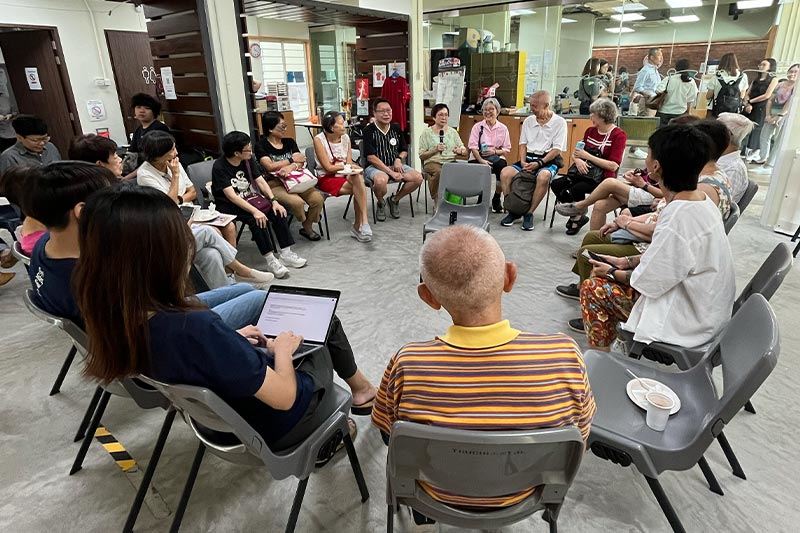
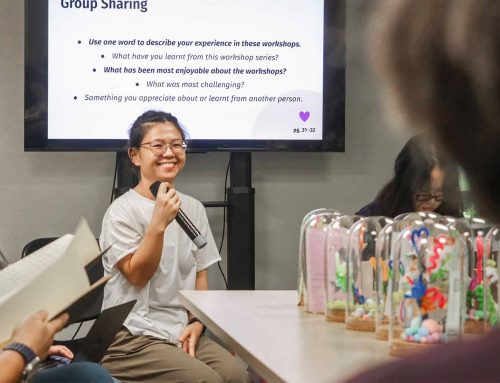
Ryan’s first encounter with Piece of Mine — sitting in on a reflection circle where seniors shared the highlights, challenges, and takeaways from their workshop experience.
What Goes Into a Word
I’ll begin with the word that spawned my ongoing engagement with this matter. Senior. Why do we use it? The immediate ‘no, duh’ answer is respect — senior acknowledges the entirety of a person’s life, and encompasses more than just the age that words like elderly foreground. To refer to someone as a senior — as your senior – is to recognise the fullness of their experience. It is a term that comes pre-loaded with respect.
On the surface, there’s not much immediately ‘wrong’ with “old guy” as a descriptor. If you’re trying to point out someone in a crowd, you reach for whatever’s most visually evident, and age is usually right there on the surface. The unfortunate truth of the matter is that — for all his industriousness in attending night school — calling him ‘that industrious guy’ is just not nearly as convenient. When old is the qualifier, it tells you one thing about him — his age — and stops short. A man and his lifetime with its multitude of experiences had, through my shorthand, been reduced to just an old guy.
Before you start thinking that we agonise over every word we say at lunch, none of this is to say that we should start policing ourselves into nicer descriptors in casual conversation. But copy, in this context, is not conversation. When you’re writing for an organisation, you have the benefit of time, of drafts, of other eyes on the page — and with them, a responsibility to use those resources well.
When we write copy at ArtsWok, word choices don’t happen just because someone has good instincts (though that helps) or plays lots of Wordle. Instead, a draft goes around the team, someone flags a word, and then we talk about it. Sometimes (oftentimes, really) at length. The conversation can be quick — “we don’t use that one, here’s why” — and other times it can be a negotiation, because the ‘right’ word doesn’t always exist in the form you’d like it to. Sometimes you just have to bite the bullet and figure out what you’re willing to trade off.
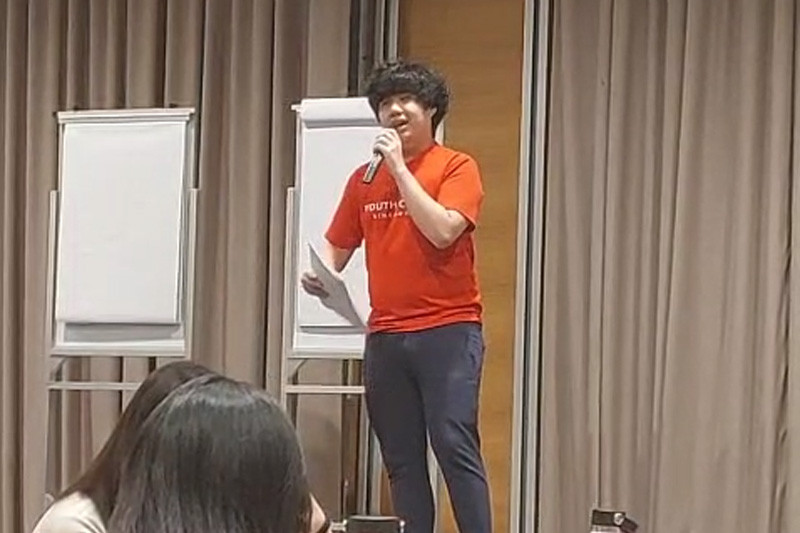
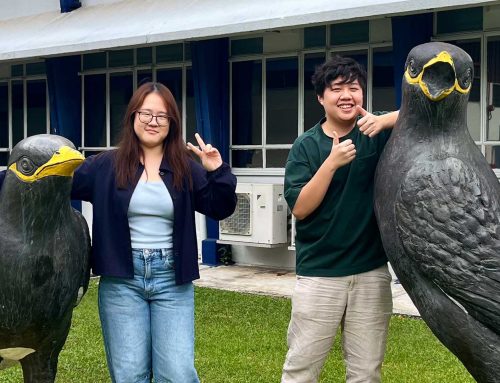
Ryan reflecting on his internship journey at a Youth Corps Community Internship (YCCI) session, where interns exchanged their experiences with one another.
Case in point: the word empower. It’s a nice one — lots of warm fuzzies gesturing at inner strength and rising up and overcoming. In my time at ArtsWok, I’ve learnt to avoid that word like the plague, no matter how much I want to reach for it because of how deeply embedded it’s become in narratives about self-determination, agency, and all sorts of other pleasant sentiments.
Don’t get me wrong — in the overwhelming majority of contexts, it’s a perfectly fine word. Right now, I could say that I feel empowered to write this essay after spending six months with the company and knowing that my colleagues trust me to not say something inflammatory, and it would be a totally valid use of the word.
But when I’m writing for a charity that’s bringing its work into the heart of communities — a charity whose work I keep reaching for empowering as a descriptor — I’ve had to reckon with what that word implies. Empower unfortunately carries the suggestion that the people we work with are powerless without our intervention. It implies we are the arbiters of power and assumes they do not have agency of their own.
Which is the total opposite of warm fuzzies, and contradicts everything that we actually believe about agency.
Hint: That’s also why we have the glossary! We now have, for example, definitions written down on paper somewhere, so that anyone from a future intern to a curious reader (like yourself!) might one day read through it and understand ArtsWok’s perspectives.
To that end, I think it comes down to being aware of, but not necessarily cautious of, the weight of our words. Even now, I’m doing it — I’m hedging against the use of caution, because that suggests we’re looking over our shoulders at every turn and combing the dictionary for the most neutral, inoffensive synonyms possible.
Take the distinction we make between complex and complicated. In common parlance, they have a large overlap in use, and are practically synonymous with each other. Starting out, I could never pin it down: Which is the word we try not to use in copy? Was it complex or complicated?
It’s a matter of precision — complicated implies that something could, in principle, be simplified. That the difficulty is a problem to be solved. Complex, on the other hand, acknowledges that some things are irreducibly layered, and that those layers are not necessarily a flaw. When we talk about end-of-life conversations in our material, those conversations are complex. Not complicated.
Even then, it’s not a particularly self-evident distinction, much less one most would agree is meaningful. We use complex because we’ve thought about it and decided it better reflects our work. We could be wrong. We put it out there anyway, aware of the uncertainty, because the alternative — never committing to a word until you’re certain it’s unassailable — means never putting anything out at all.
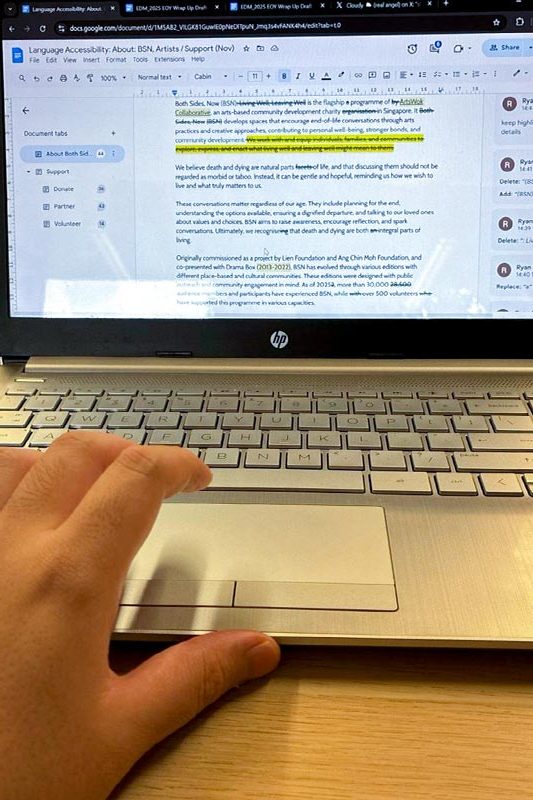
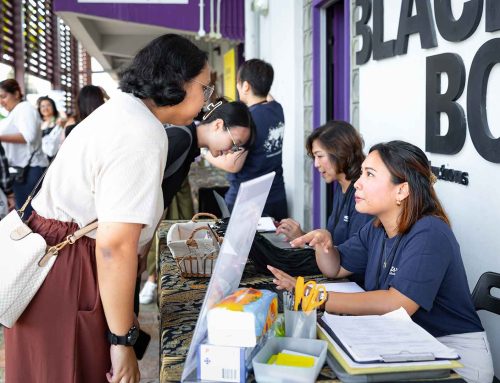
A glimpse into Ryan’s day-to-day work of writing, reviewing, and responding to comments across the many documents he worked on during his internship.
The Final Question
“That’s all very well and good, Ryan, but what are the answers?”
The ultimately unsatisfying (personal!) conclusion I’ve arrived at after six months is: “Bah, it depends.” What goes into the words we use isn’t whether these words are good or bad. Our relationship with language is fundamentally about contextual awareness — knowing what a word carries, who it’s being used on, what it says about the speaker and reader’s assumptions alike, and whether all of that appropriately reflects the work we do.
All that to say, it depends on the holy trinity of every English class I’ve ever taken: Purpose, Audience, and Context. The purpose of this very essay is to serve as an introduction to ArtsWok’s glossary for you, the audience, within the context of the work that we do.
You might’ve noticed a few of them floating around our website. Artist-facilitator. Collaboration. Intermediary. Over the course of the glossary project, these and other words went through the same process I’ve been describing — drafted, discussed, everything short of being sent to a lab — against the question of “What does this word actually mean when we use it, and does that meaning hold up?” To make sure that they’re internally consistent, we’ve gone as far back as 2016, pulling from definitions scattered across older publications to ensure that the new entries in our glossary incorporate them — or, at the very least, don’t contradict them.
The glossary covers the terms that come up most often in our communications — words for the people we work with, the roles we play, and the relationships between them — and for each one, it seeks to set out not just a definition, but the reasoning behind it: Why this word and not another, what it’s trying to accomplish, and what it’s trying to avoid.
It’s not a dictionary of correct usage, but it is a document of how and why ArtsWok has arrived at the language it uses, written in the hope that it’ll be useful to anyone who works with us or wants to understand our approach.
And if you’d like to see what we have landed on, you can now check out ArtsWok’s glossary here.
About Ryan Chia
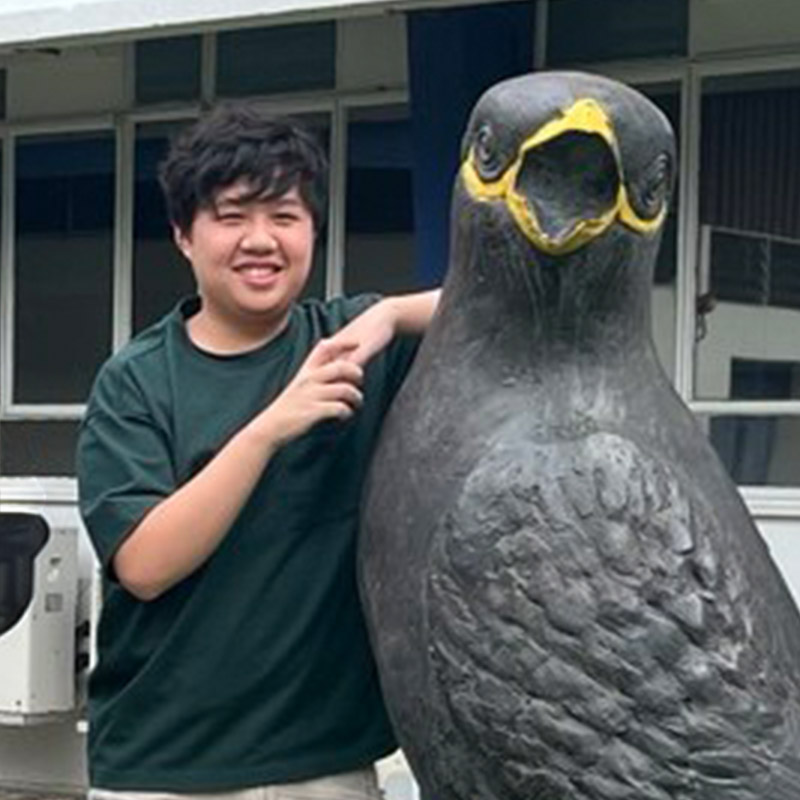
Armed with a Diploma in Story and Content Creation from Singapore Polytechnic and a deep curiosity about how people live, Ryan recently wrapped up a six-month internship with ArtsWok as our marketing and communication assistant. Today, he approaches storytelling with a newfound attentiveness to nuance, perspective, and the power of choices.