Library / Field Studies
Reflections on Disability, Accessibility and the Digital in “What If”
Library / Field Studies
Reflections on Disability, Accessibility and the Digital in “What If”
Written by Kirin Heng
Researched by Clara Lim
10 February 2021
The Beginning of What If
Last year, amidst planning M1 Peer Pleasure’s 2019-2020 iteration on the issue of disability in Singapore, we reached out to Okorn-Kuo Jing Hong to invite her to direct a play. This play1 would be fronted by a cast of people with disabilities in Singapore, with the aim of spotlighting their points of view, without exploiting their lived experiences for the spectacle. Initially, the title of What If arose from this desire to excavate these experiences: in Jing Hong’s words, What If stood for many open-ended questions. “What If people with a disability, are seen as not having a disability, but their disability as an opportunity, without avoiding and negating what their life has been and the challenges that they have to go through? So in that sense, their experience of having a disability creates a different perspective of expression.”
And, with Covid-19, causing our production to move online, these questions of what if grew in number.
The designers of the production played a non-traditional, much involved role from the outset. They were invited by Jing Hong to be part of the devising process, as she noticed they seemed to be a group of sensitive, proactive people, with the predisposition to be curious – and empathetic – about different points of view, informing their design. And later, during the shift to the digital, when access to the show would be more dependent on the senses of sight and sound to carry the performance to audiences via the internet, they took on the roles of co-creators. Alongside this transition from a theatre show to an online one, New Media Director Lim Shengen was brought onboard to facilitate this. In contrast to most of the team who were experienced in theatre, Shengen was an artist with a background in fine art and design.
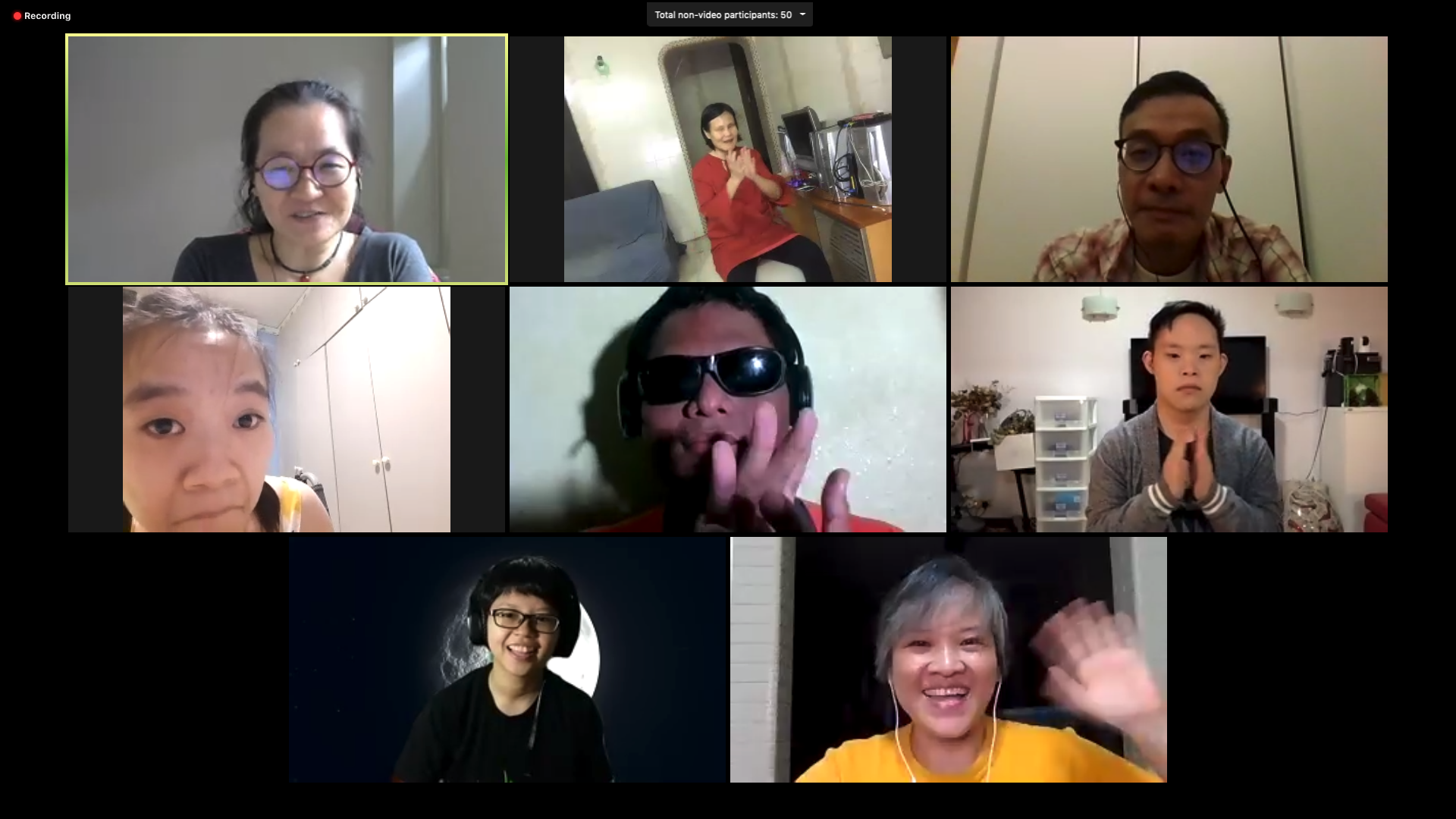
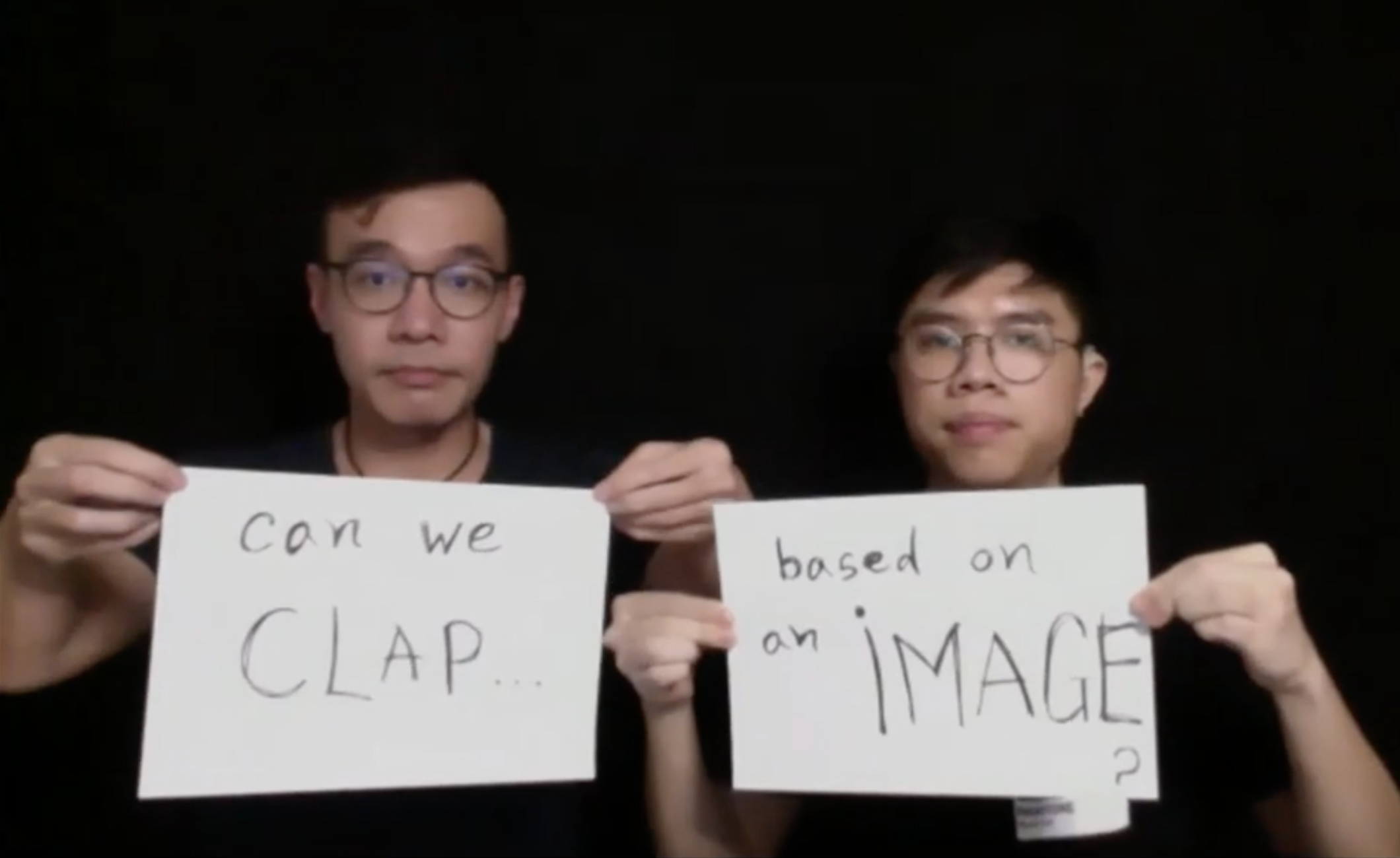
Frozen. Broken. Poof!, post-show dialogue screen capture.
Hence, this made the creative process of What If a cross-road of sorts, in which many different backgrounds, experiences and lenses played a role in shaping each piece. What If has been a collaboration between designers and artists, traditional theatre-making and New Media, people with disabilities and people without disabilities. Each step of the way, an effort was made to translate different languages and points of view to one another. This whole process of collaborating across differences was one of learning.
Through this piece2, we hope to share our experience of trying, for the first time to make an original, devised and digital production with a very diverse team, with the aim of spotlighting the perspectives of our cast who have disabilities. This piece is an amalgamation of the voices of each of us who were involved in this process, and our experiences, based on a series of interviews ArtsWok, as the festival producer, conducted with the cast, designers, production manager, and directors. We hope that these sharings of obstacles we ran into along the way, and things we learnt, might create questions, and points of consideration, for anyone in the arts and outside, hoping to do a collaboration with disability as one of the factors in mind. We do not claim expertise nor prescriptions on how to shape a production, but hope that our work with What If might provoke you into thinking further, and inspire you to start collaborating with people whom you might not have thought of connecting with before.3
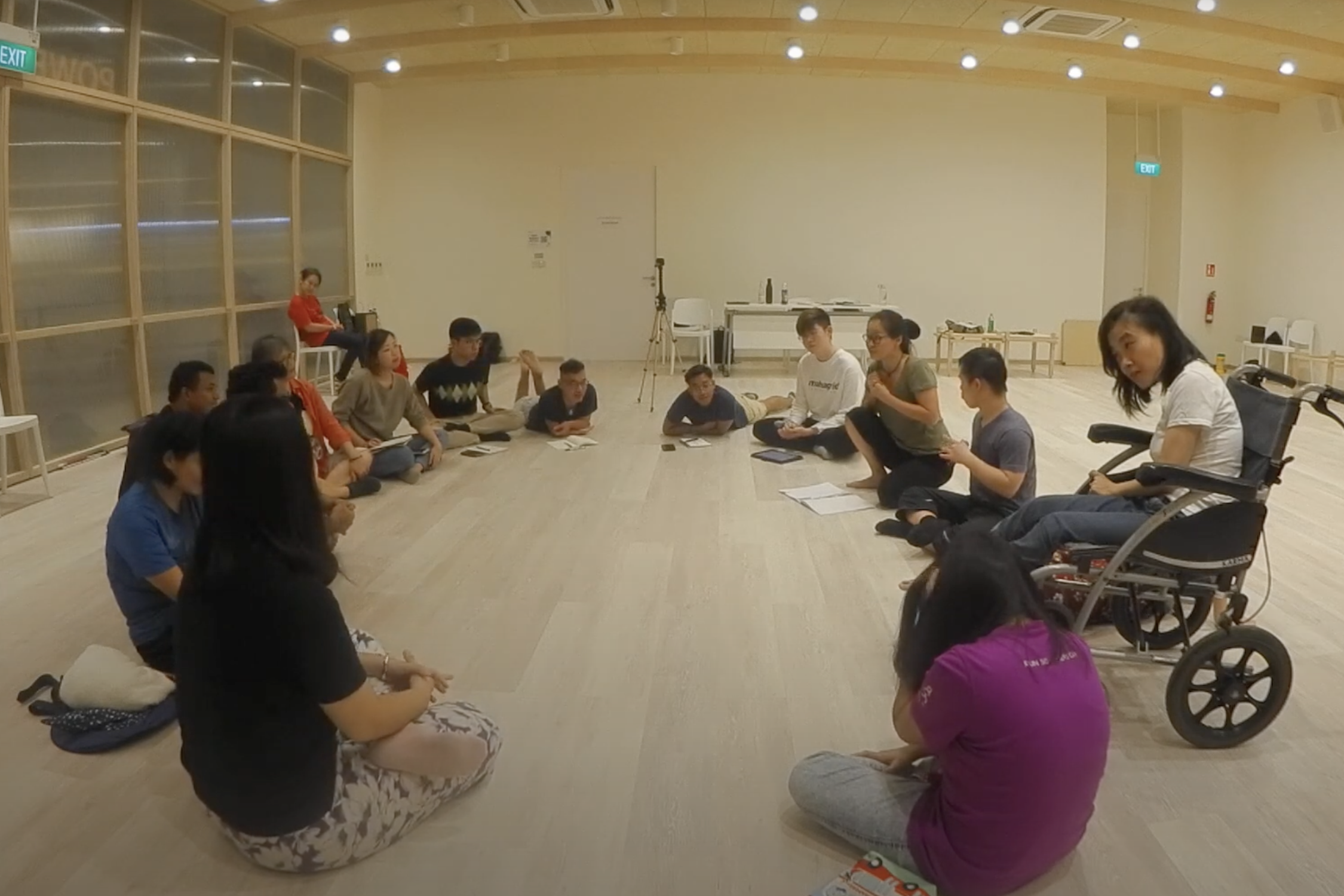
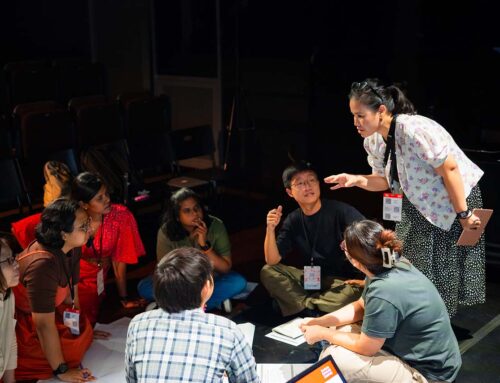
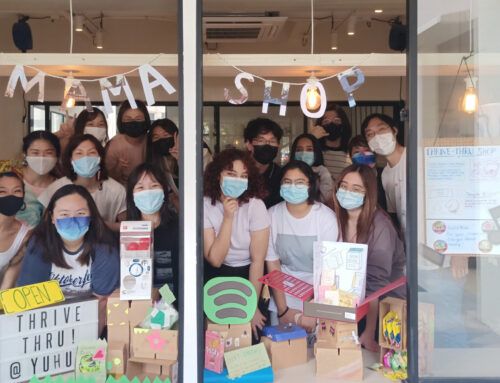
The cast, designers and creative team of What If in Tzu Chi Humanistic Youth Centre during the devising process, before Covid-19 restrictions.
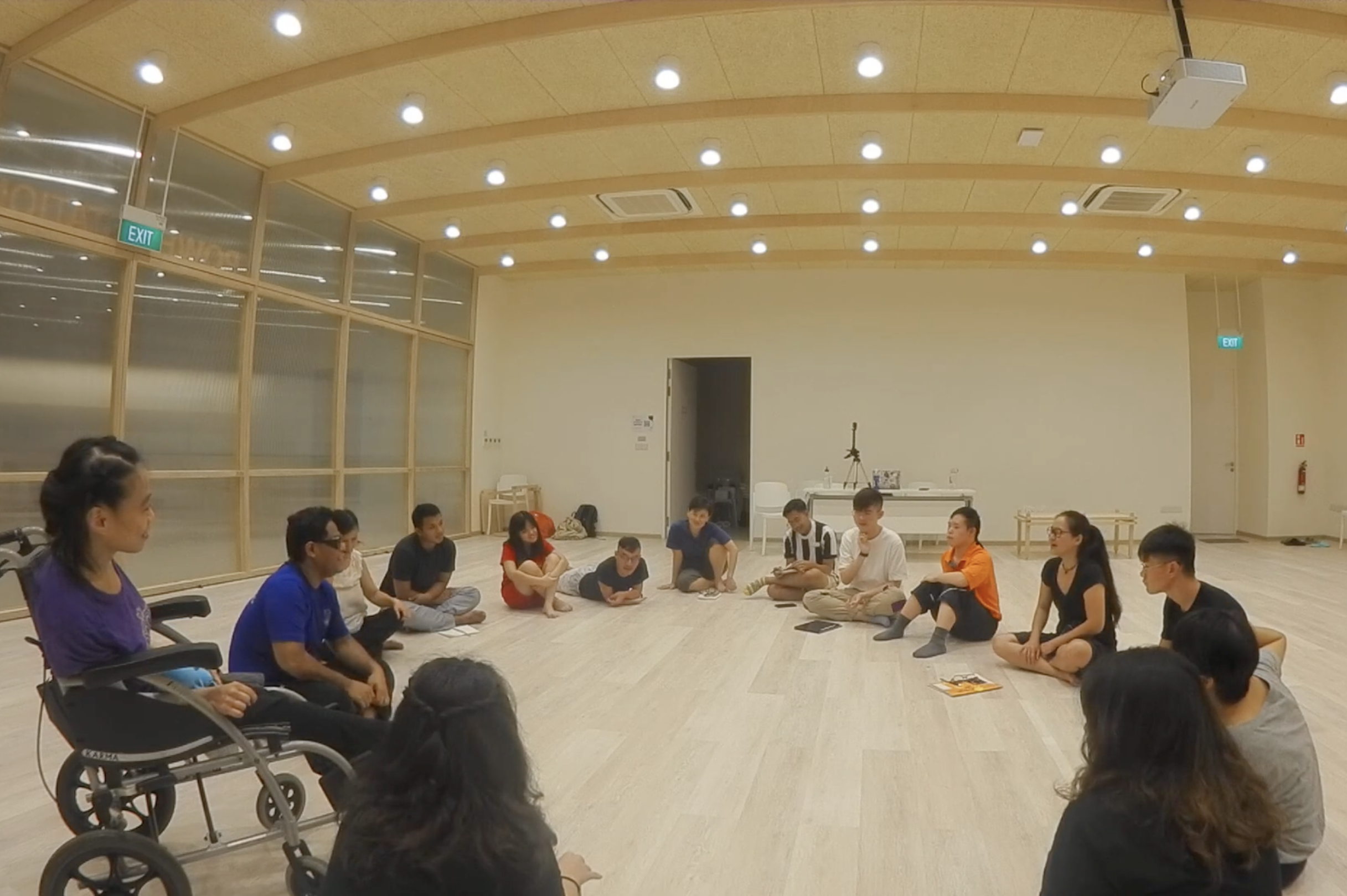
The cast, designers and creative team of What If in Tzu Chi Humanistic Youth Centre during the devising process, before Covid-19 restrictions.
What does Disability mean in What If?
As far as the producers, designers, and production and stage managers were concerned, we set out not knowing much about the nuances and specificities in the experiences of those with disabilities. In order to make an informed, responsible festival, a resource panel consisting of researchers, educators and advocates was assembled. While they were consulted from the outset, having a set of specialists on disability was not enough to inform us about working with a cast of people with disabilities, simply because each person has their own preferences, regardless of (dis)ability, and only through asking questions specific to the scenario are we able to provide an inclusive environment for both artists and audiences with disabilities.
Given that our festival’s theme was disability, specifically a youth theatre festival exploring the social issues surrounding disability, we were cognisant of the fact that we might be at risk of pigeonholing the wide array of disabilities into a few plays. Each step of the way, we sought to keep in mind our original goal of trying to spread a deeper or different awareness of disability in Singapore, in a nuanced, responsible way, and in consultation with various points of view from the community themselves.
Having the five cast members, each of whom has had a different experience with disability, was very valuable to informing the way the festival was shaped. To start from square one, we asked them what disability meant to them, to which we received a variety of answers, some of which are:
lvni, who also has a vision impairment, and is cast member Wan Wai Yee’s partner in band Strawberry Story, assisted her during What If. He added:
Tan Beng Tian, our Assistant Director, had an interesting perspective to add:
Language is a crucial factor to consider when portraying communities. We learnt about some of the intricacies and politics of each term that is used to refer to different disabilities, especially through our marketing. Unfortunately, sometimes we did not realise this before launching content to the public, and were kindly corrected by people in our comments or through acquaintances from the disabilities community. Our Assistant Producer Charlene Haridas reflected on this:
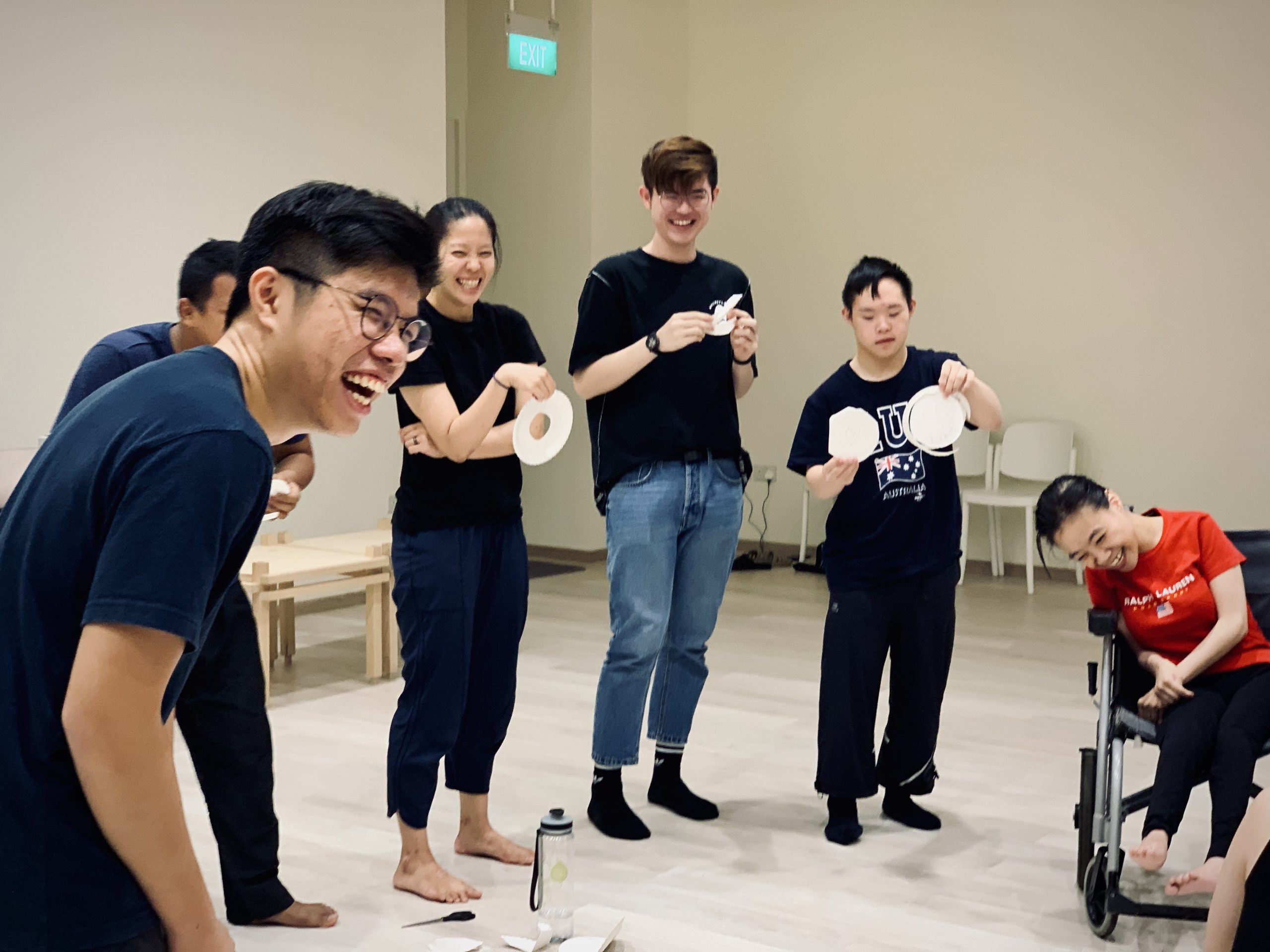
The cast, designers and creative team of What If in Tzu Chi Humanistic Youth Centre during the devising process, before Covid-19 restrictions.
Adapting to one another and the digital in What If
One vital question that Jing Hong bore in mind while devising and rehearsing What If was: How should they organise a dynamic of integrity in which the cast and Timothy (one of the designers), who had disabilities, and the production team and designers, who were so-called non-disabled, would have equal space – especially bearing in mind the bigger environment of society in which able-bodied people dominate the mainstream?
Initially, when they were in a physical rehearsal space at Tzu Chi Humanistic Youth Centre, Jing Hong set aside the time before the process of devising began to allow everyone to acquaint themselves with the space, and find their own ‘corner’ in which they could feel comfortable during lull periods. For the two performers who are blind, Hidayat and Wai Yee, the spaces were described in detail, and volunteers who had been brought onboard for the rehearsals were on hand to help them navigate only when the former would not be able to by themselves using their senses of sound and touch.
Another layer of vulnerability for the cast was the fact that they would have to perform in front of the whole team during the devising process. Jing Hong realised that this would be intimidating, given the double vulnerability of performing something they each created. Thus, she decided to make the rest of the team create and present a piece of work so that they would have a hands-on experience of the technical and psycho-emotional journey of creating and presenting a performance. This was an equalising tool which allowed the non-cast members to empathise with the intimacy of using one’s own body as a medium for art.
And another question: What would theatre mean once its physical stage was dissolved into an online production, given that the integrity of theatre is traditionally rooted in physical space?
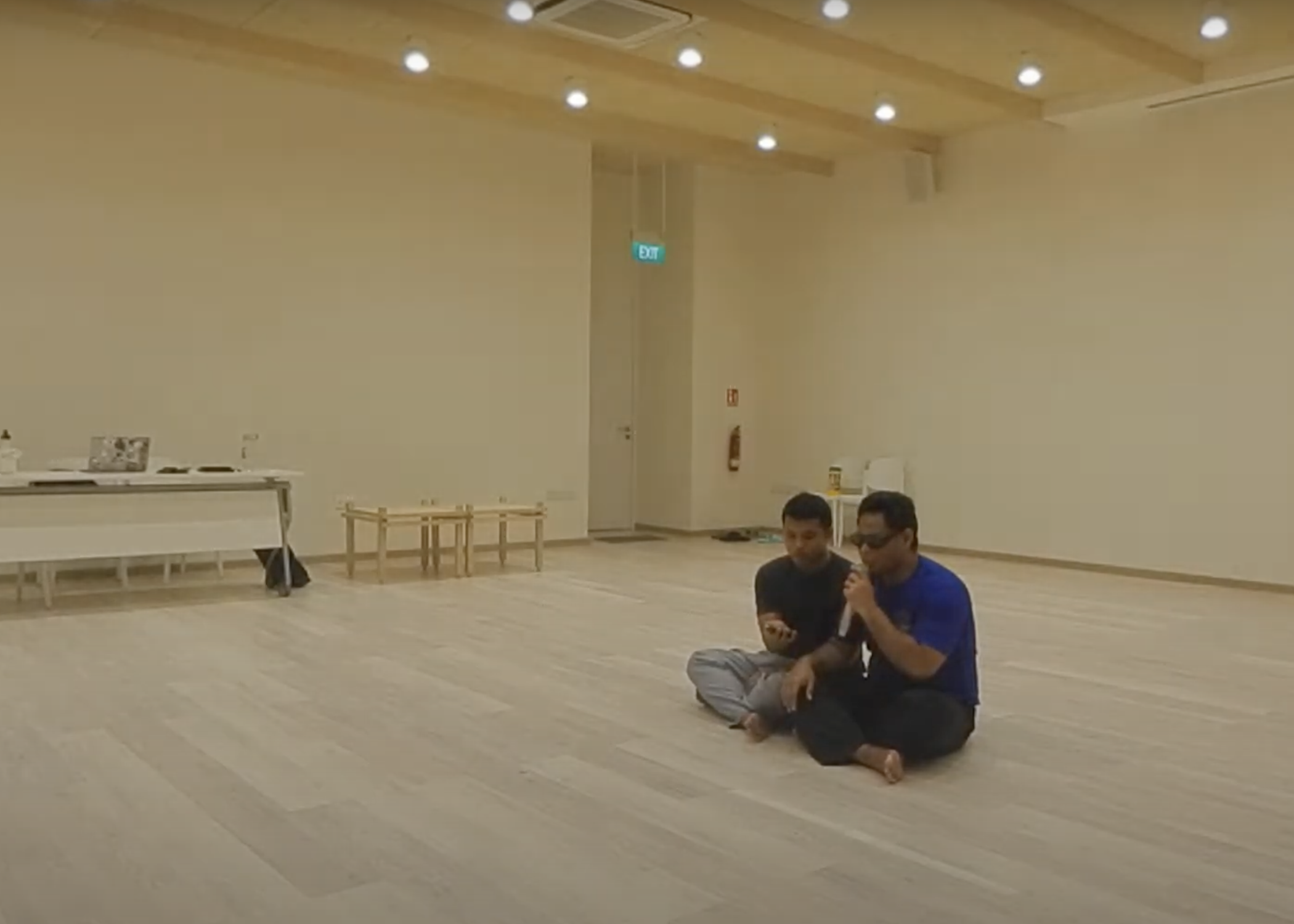
Volunteer Zul with Hidayat during a What If devising process rehearsal at Tzu Chi Humanistic Youth Centre.
When the production migrated to Zoom, everything became 2D, and everything you saw of the person and their space was partial. This meant sighted people had even more of an advantage than normal, as people who have vision impairment would have only one sensory apparatus left (sound) to rely on. Now, more than ever, the team would have to make the effort to proactively communicate with one another and synchronise.
Clarisse Ng, our Production Manager, was confronted with this big shift: many questions arose as the role of Production Manager was completely transformed.
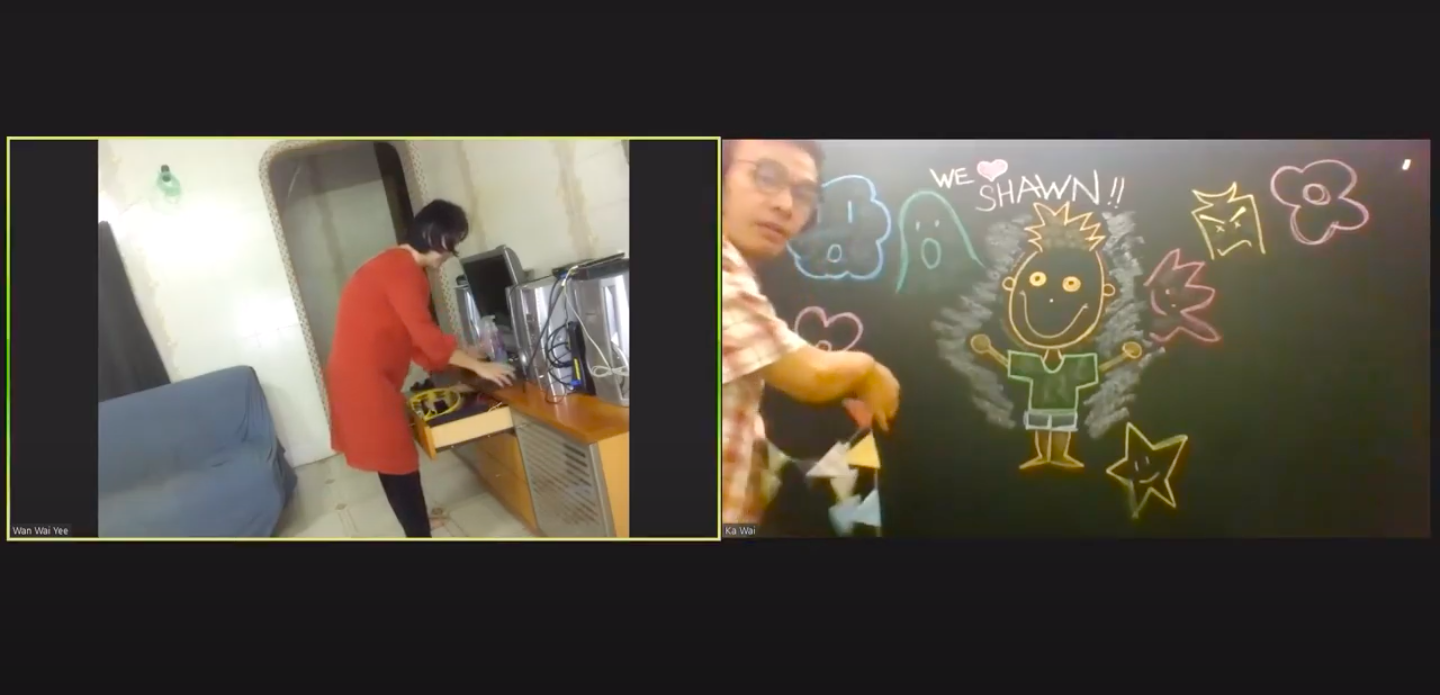
Frozen. Broken. Poof! Left: Wan Wai Yee, right: Tung Ka Wai. Screen capture from show.
Ka Wai shared5 as a long-time theatre practitioner himself, this unprecedented situation of using his room at home as a stage gave him new ideas to contemplate:
Yet a difficult period for our cast member Stephanie, who has cerebral palsy and uses a wheelchair, was the Circuit Breaker, during which access workers6 were not considered Essential Workers.7 Without her access worker, Stephanie was unable to participate in warm-ups with the rest of the cast, and had difficulty recording her own voice for her poetry for one of the devised pieces while reading it on the same device. For outsiders who may think that going online may be of benefit to people who have disabilities with access needs, Stephanie does not concur. For herself, she preferred to be able to demarcate work and home as an artist, and to be able to travel to the rehearsal space (with the help of an access worker).
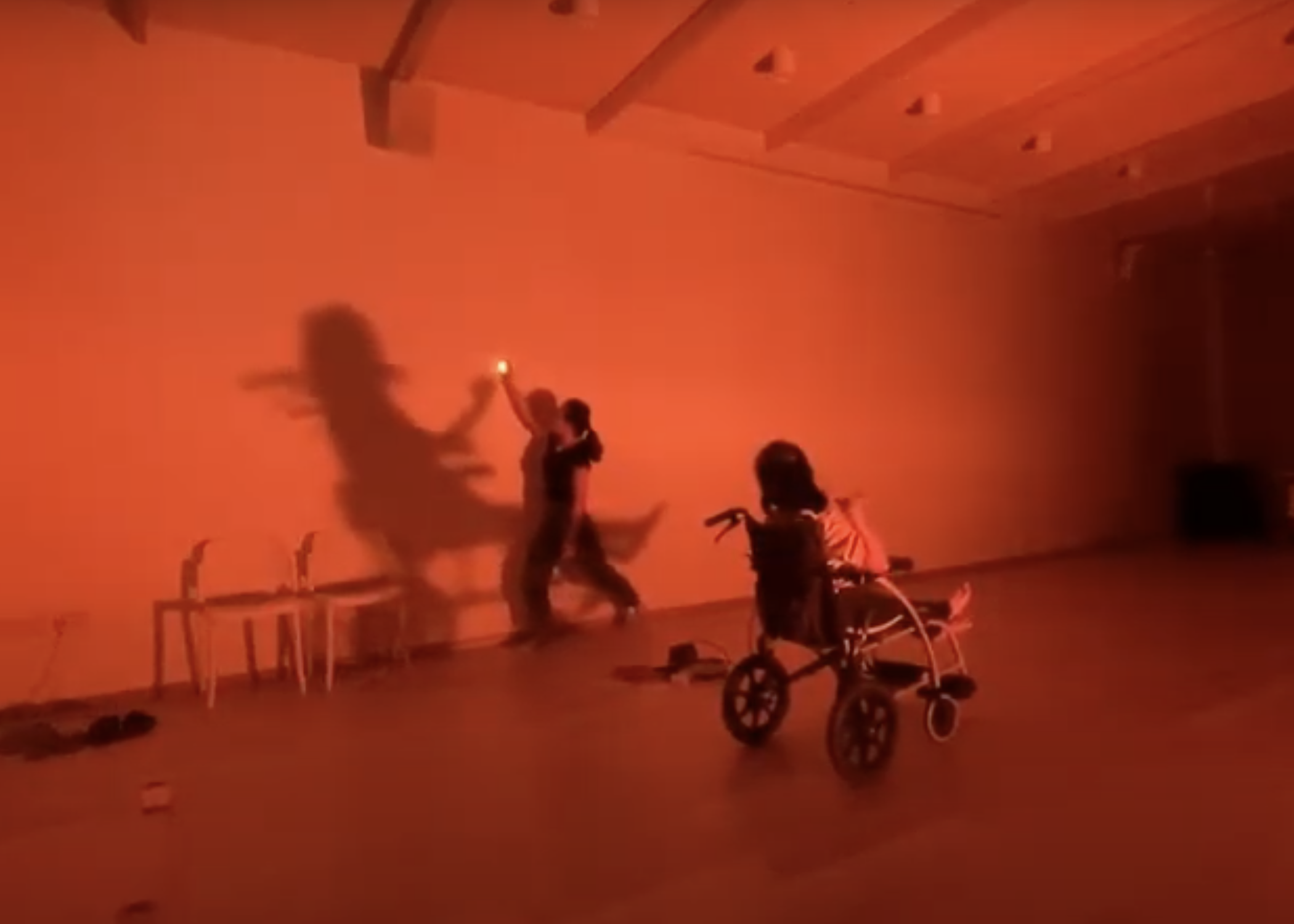
Stephanie Esther Fam performing with her access worker Yi Wei, during devising process at Tzu Chi Humanistic Youth Centre.
Meanwhile, Shawn’s family stepped in to help him with rehearsals. While we had hired access workers for Stephanie, and put out volunteer calls to assist Wai Yee and Hidayat, we had not made arrangements for Shawn to have an access worker. As someone with an intellectual but not physical disability, it had not occurred to us that he might need one. However, an indirect way of trying to make the rehearsals more accessible to him was done, through frequent check-ins to ensure that he was on the same page as the rest, much like doing audio description on Zoom for Hidayat and Wai Yee during rehearsals.
This brings us to our next section: that accessibility is not a one-size-fits-all, and the key to it is communication.
Communicating towards Accessibility in What If
Accessibility in the arts has two objectives: making it possible for artists with disability to make their art, and for audiences with disabilities to access art. Both are still in their growing stages in Singapore. Clarisse shared that this is still in its nascent stages for the theatre scene in Singapore. While we had planned for and budgeted for actors with disabilities from the very beginning, we asked Clarisse what they would have done differently, and they shared:
Beng Tian was asked to be our Assistant Director largely owing to the fact that she has background knowledge on accessibility, such as in directing Not In My Lifetime?. However, she had other responsibilities to handle besides accessibility needs.
During our interviews with the cast however, a recurring point was that no one can be an expert on accessibility. Instead, it can often be highly personal. Stephanie pointed out to us that the word accessibility is a paradox – while it strives for all-inclusiveness, in conflating this striving into one word, it makes it “linear”, and does not seem to take into account the plurality of the experiences of disabilities. Therefore, she stresses on the need to never assume when it comes to accessibility, and always ask the person in question whether something is working, and how else it could be done to make it easier for them to make their art, or experience the art, especially if the person is too shy or too afraid to speak up. “If you don’t ask, you won’t know. Different people have different access needs.”
It is important to not allow our fear of offending someone hold us back from asking the difficult questions, as long as they are asked from a place of sincerity. Through asking them, we provide space for indispensable conversations to be had.
Indeed, access preferences were varying for each of our cast members. Shawn revealed the key to his own lingo is breaking instructions into step-by-step, perhaps not needing an access worker so long as someone takes the time for this. For instance, in her voice training with him, Beng Tian read each line out to him when recording for the What If Aliens animated shorts.
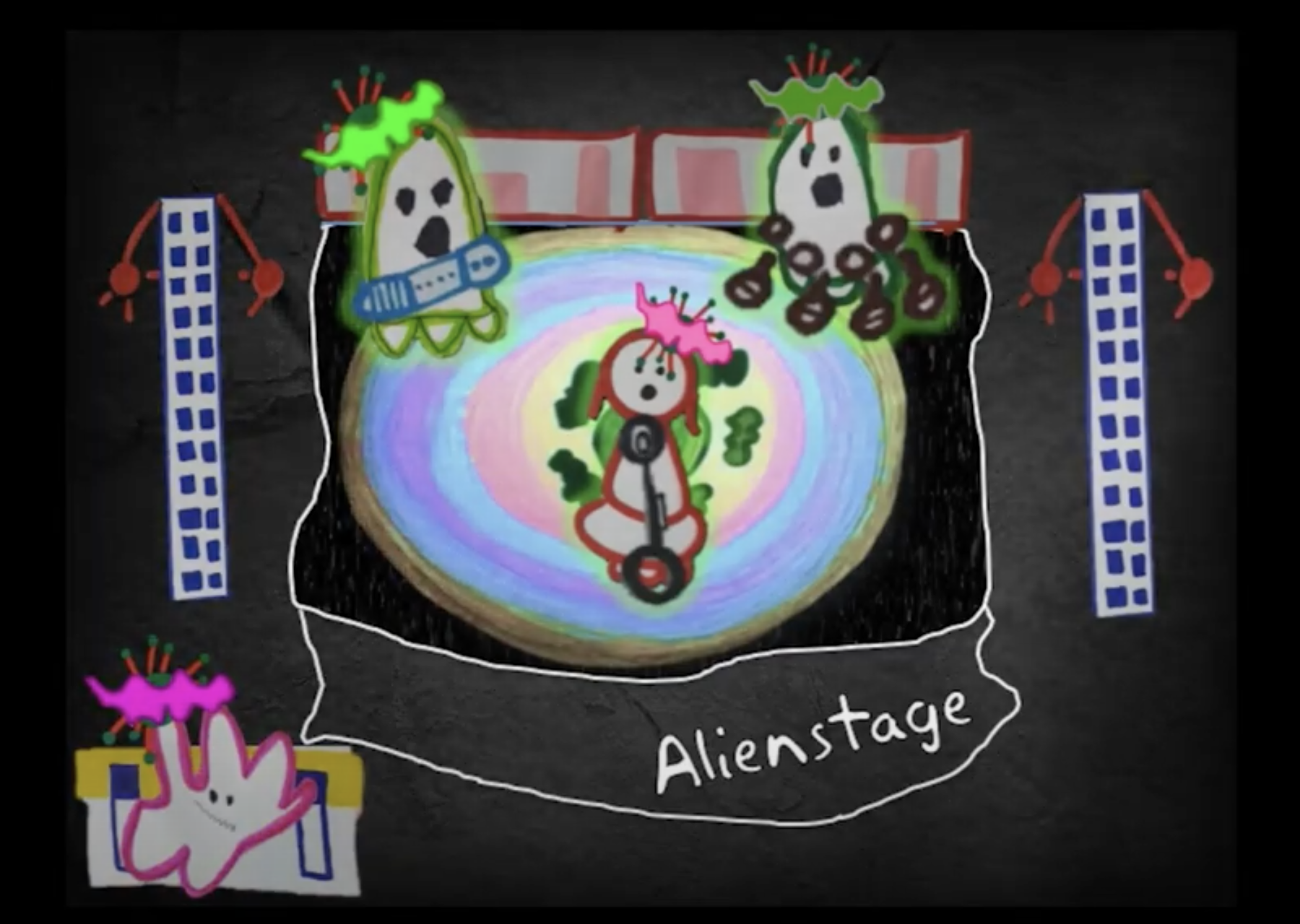
What If Aliens: Planet Ambyond. Screen capture from show.
Even the same person may have different access needs over time. Wai Yee pointed out:
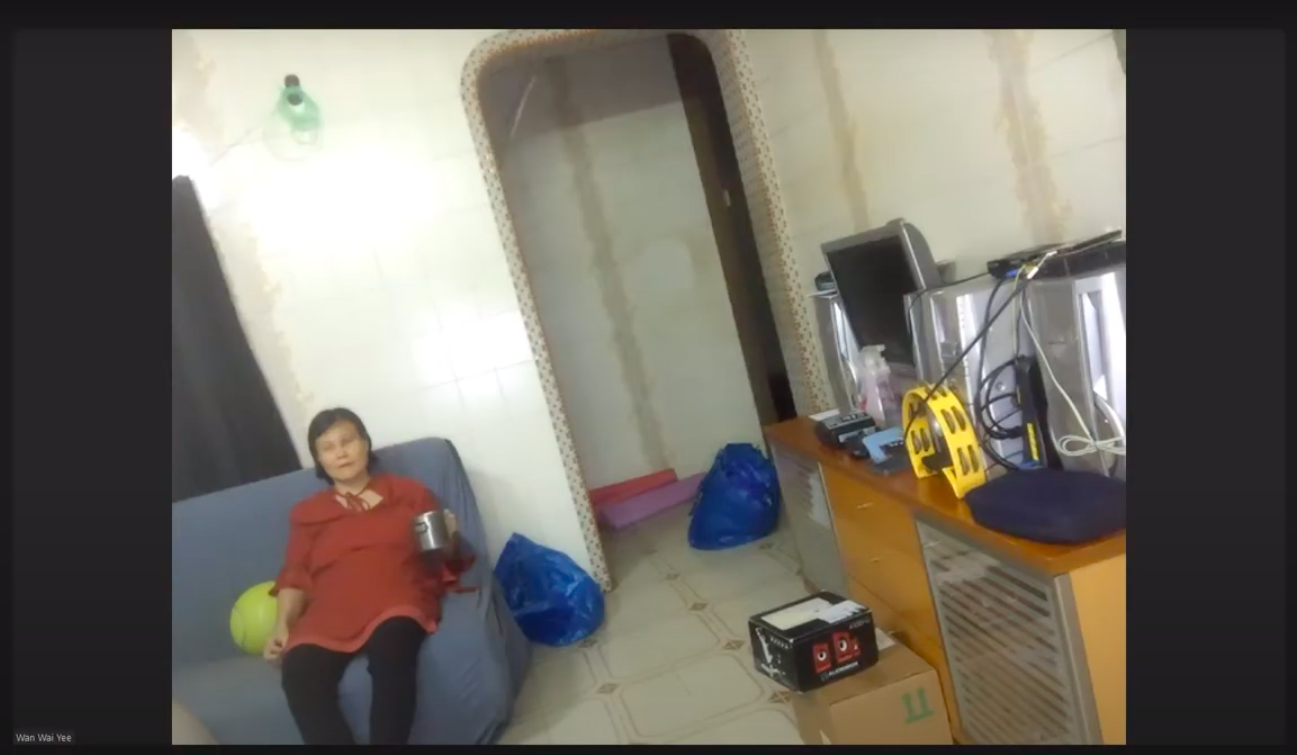
Wan Wai Yee in Frozen. Broken. Poof! Screen capture from show.
Due to the Circuit Breaker, Wai Yee had to learn how to film herself for Frozen. Broken. Poof! , and take into account things such as camera angles and lighting, despite not having considered it before as someone who is blind.
A curiosity to learn more about people and stand in their shoes is extremely useful in striving for accessibility. Beng Tian, who is an independent theatre practitioner, began her interest in accessibility in theatre after she became friends with people from the vision-impaired community a while back. She stressed the importance of this first step towards accessibility, in not just remaining acquainted with, but truly getting to know people who have disabilities; such that you begin considering them in your everyday, and letting curiosity of how they may perceive your work, or how they might not be able to, guide how you shape it.
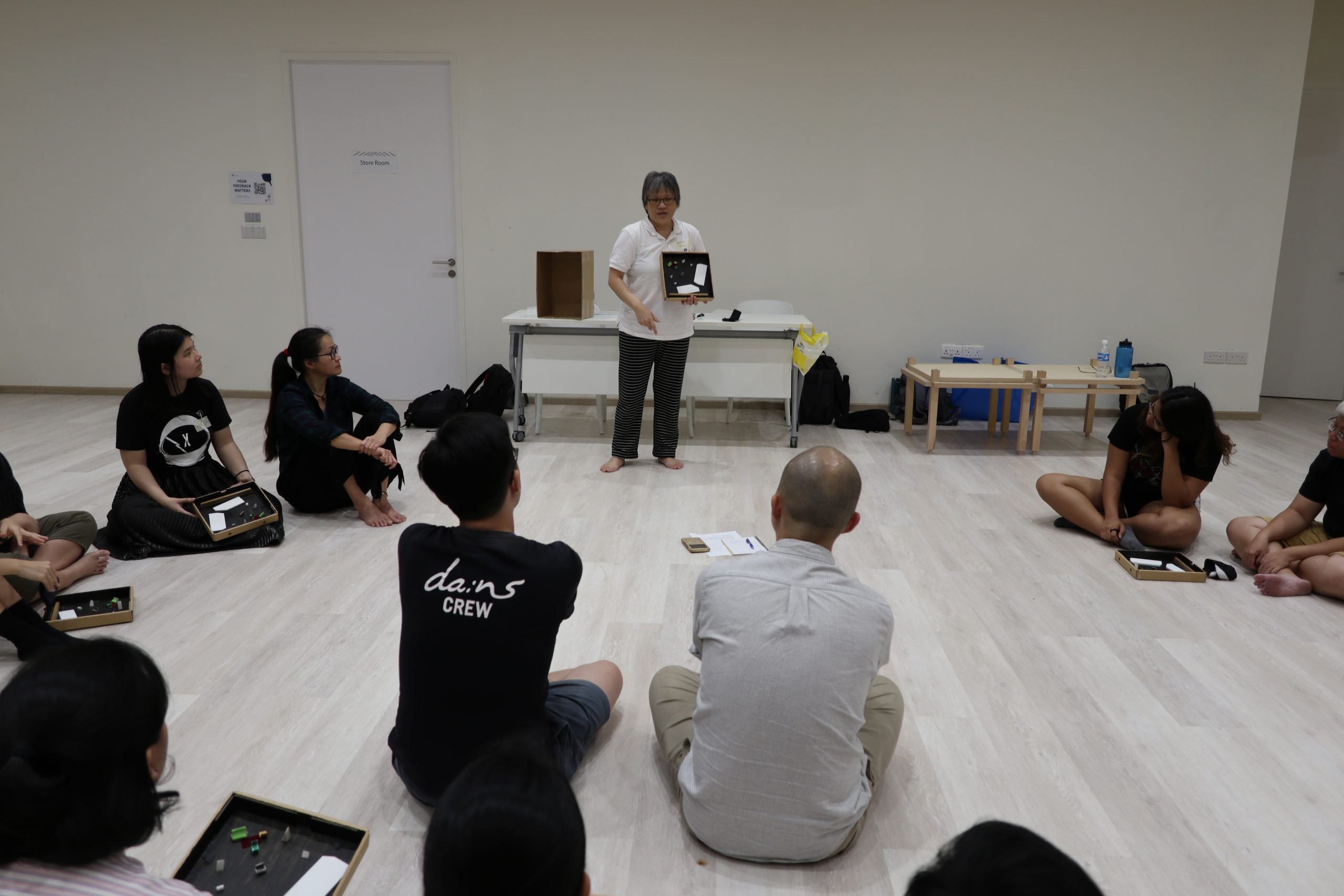
Tan Beng Tian during a training workshop at Tzu Chi Humanistic Youth Centre, conducted to equip What If’s volunteers and crew with the knowledge and sensibilities to support the production.
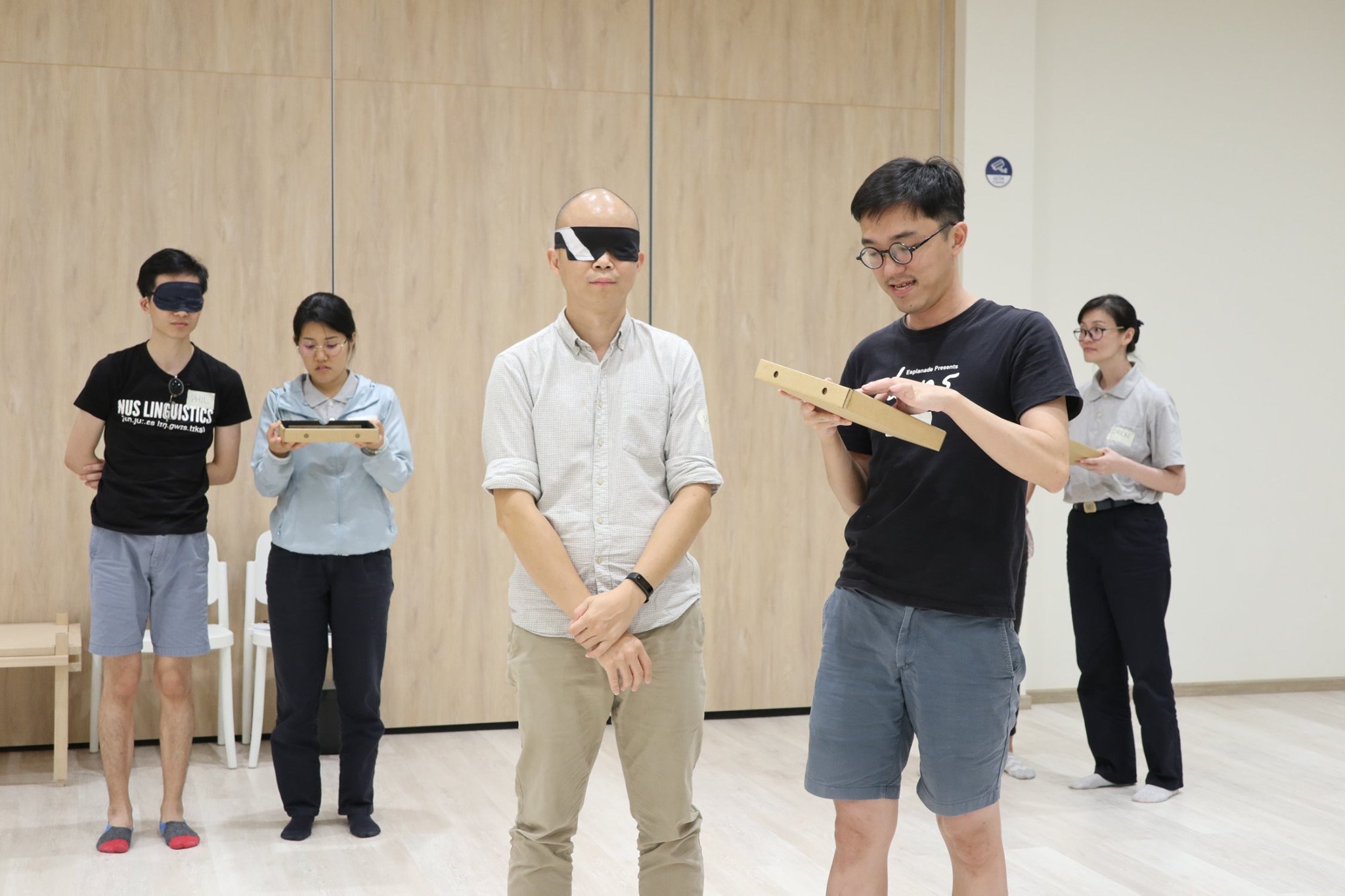
Volunteers during training workshop about accessibility at Tzu Chi Humanistic Youth Centre.
Another way of approaching accessibility is by seeing it as not merely in relation to disability, but a mode of creativity. Lim Shengen’s role of New Media of Director was created to adapt to the changes of going digital, and help bring What If online. He shared:
Stephanie stressed on this principle that artists should adopt to reach out to all sorts of audiences too:
Accessibility is intricately tied to how we live everyday life, in things that we may normally take for granted. For instance, we found that ticketing platforms like SISTIC are not accessible to people who are vision-impaired, and soon realised neither is internet banking. Charlene shared:
A Space for Artists with Disabilities to Grow
The field of disability arts – art by disabled artists about their experiences of disability – is growing in Singapore. However, to a practising artist who happens to have a disability, sometimes the term “disabled artist” is thrust upon them without their choice, and their art is perceived to be defined by their disability.
Stephanie shared about this dilemma: To say that I need those labels would not be true. If someone were to physically see me, they obviously know that I’m already disabled. But I do it because you have to survive in this society and you have to state your place in a society that doesn’t otherwise see you if you don’t. To me, I’m an artist first before anything.
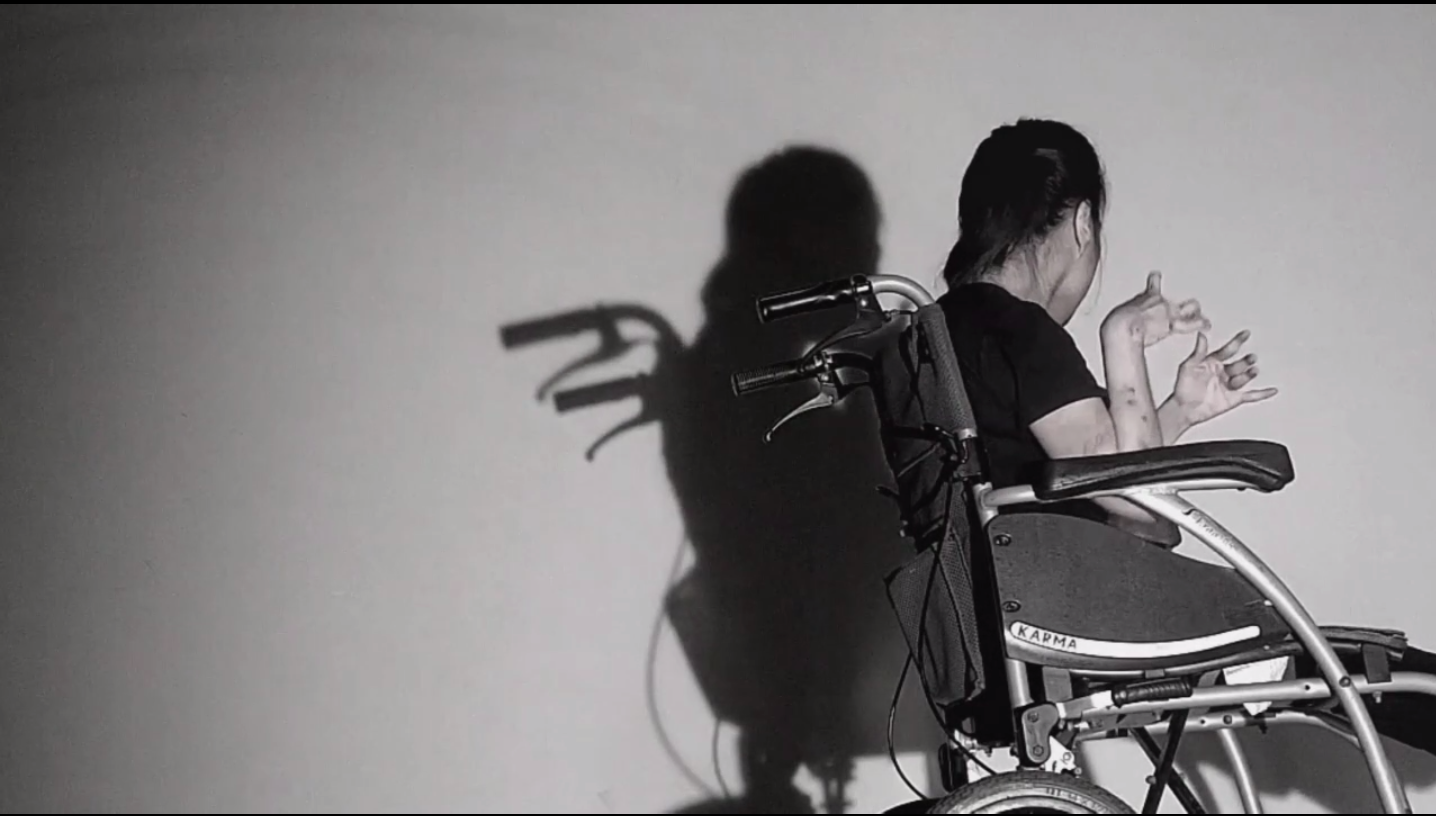
Stephanie in Stained. Screen capture from show.
In a similar vein to poverty porn8, the trope of involving people with disabilities achieving a feat – inspiration porn – is often used in mainstream media to garner the reaction of awe. Yet this awe is symptomatic of an infantilising disbelief that people with disabilities are capable of such feats, a damaging prejudice that can be a barrier for artists with disabilities trying to break into the industry and be seen as legitimate artists. During her interview with us, Wai Yee related to us her experience of being at a show in which one of her friends who was blind was performing his comedy show. They had all been enjoying it until one of the organisers remarked: “Wah, I forgot that he’s blind”.
Wai Yee continued: I’m quite tired of people who say “oh you are blind, you do triathlon, oh you sing, you are so inspiring!” I mean don’t give me that nonsense, I’m just a normal person who tries to live my life, we are all the same. Don’t put me on a pedestal, I’m not a god.
Hidayat told us that he discovered his talent of using funny voices to represent different characters after becoming blind, a skill which was used during What If Aliens, in which he played a few characters in Shawn’s imaginary world. Yet he was quick to add that his enhanced sense of sound is by no means a super power, and he does not want to be seen for his disability. This sentiment was conveyed in how Fetching Sanctuary referenced a Facebook post by an American nurse, titled Do Not Call Me a Hero. Indeed, the distinction Hidayat makes is important: that people with disabilities have no choice but to be reliant on a particular ability, and this is why it is more enhanced in them.
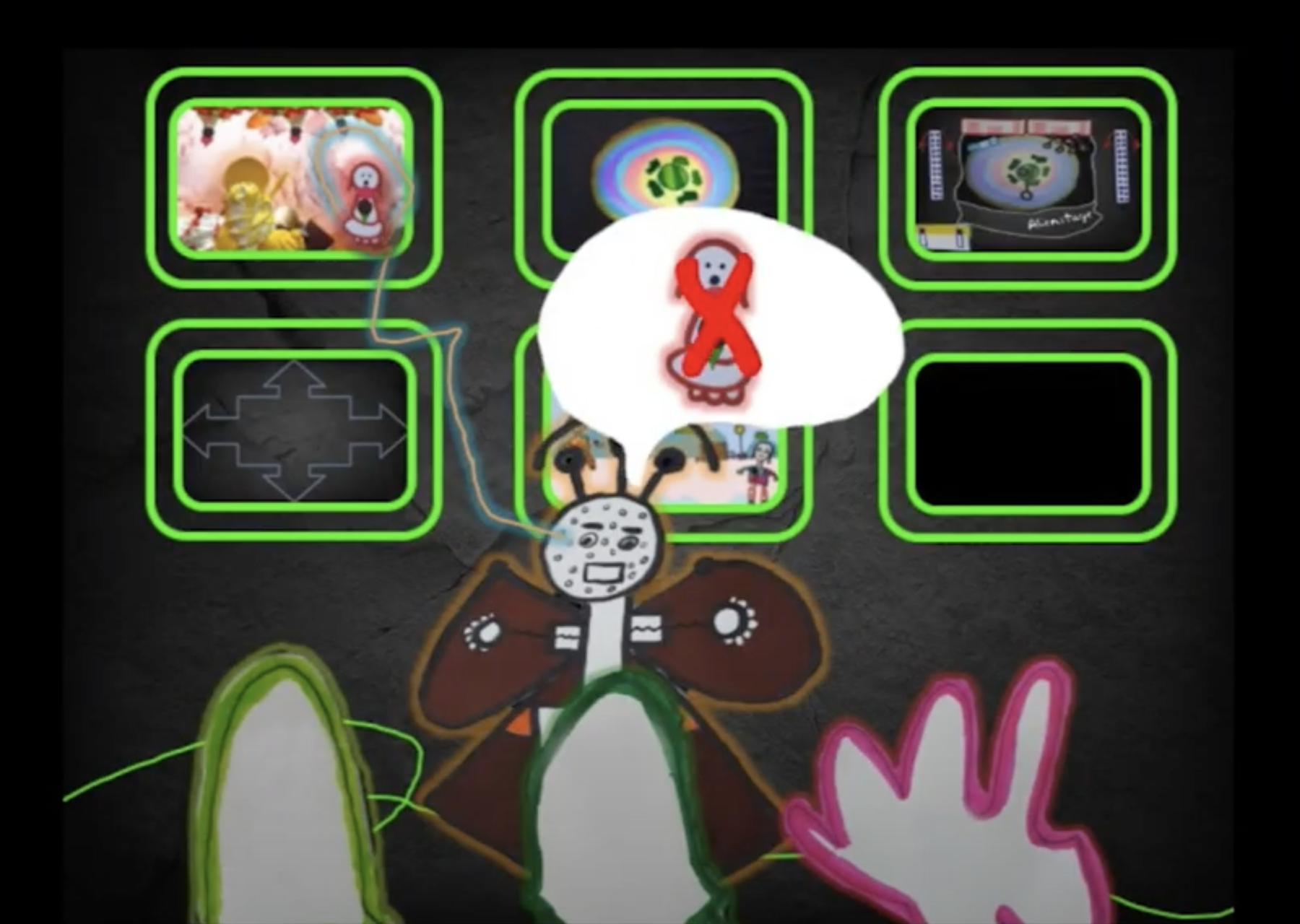
Alien Mee voiced by Hidayat, in What If Aliens. Mee is the leader of the alien species living on Planet Ambyond. He is big and burly. He receives intergalactic messages via the three antennae at the top of his head.
Similarly, upon being asked his thoughts on what disability means, our cast member Shawn, who has Down Syndrome, replied that he does not define himself as someone who has a disability: People with disabilities are people in need, special needs. They are special needs but they are not me.
The term “special needs” over time has objectified children who need special education by becoming itself a noun or adjective in people referring to such children as “special needs”, minimising them to their disability and not their identities as people. In his refusal of this term, Shawn indicated his wish to not be defined by what society has labelled him as.
Ka Wai had a humorous way of expressing this. When asked “how would you like to be mentioned as an artist?”, his reply was: I want to be called handsome!
By normalising the presence of artists with disabilities on mainstream platforms, in which they are free to make whatever art they want, without it being defined by or related to their disability by audiences, misconceptions such as the ones aforementioned can be overcome.
Wai Yee and Ivni expressed their desire for more opportunities to grow and be celebrated for their artistry:
Meeting Halfway
This was M1 Peer Pleasure Youth Theatre Festival’s last year, owing to our titular sponsor pulling out. We operated with the philosophy of co-creating work that is original, in order to bridge across difference. When there is enough time, space and resources to co-create something that is original, you are able to explore the depth of an experience, and draw out stories specific to it, to ultimately communicate it with audiences. And along the way, synapses of understanding and empathy are formed through connecting over co-creation.
Moes, Oliver and Timothy are students from Nanyang Polytechnic, who came onboard as designers for What If as part of their Final Year Projects for school. Initially, their role had been as set and visual designers. Yet along the way, their role evolved to that of co-creators, each being involved to different extents in the four shows of What If, especially since a digital production might not necessitate a set in the traditional sense of theatre. Moes was the visual designer of Frozen. Broken. Poof!, assisted in the running of operations for all four shows, and also served as a videographer alongside Oliver for Stained. Timothy had a special role in 0 dB: it was based on his own experiences of being “profoundly deaf” and discovering cochlear implants as a child.
Tung Ka Wai and Timothy Hua during 0 dB. Screen capture from show.
Their lecturer Ong Guat Teng, who served as their mentor on this project, shared that she has noticed their growth as empathetic, receptive and experimental designers through this process. For Moes and Oliver, their work with Stephanie played a big role, moving them and inspiring them to create a visual track to her poetry. And for the three of them, this experience helped them to shape their ideals for the future of an accessible arts scene in Singapore, one that they have the potential to shape.
This piece ends with a question: how may we, as audiences, create a desire and movement for more art which is driven by artists with disabilities? How may we, through our demand, create an industry that is open and conducive to their work? For it cannot always be people with disabilities advocating for themselves.
We would like to shoutout projects and arts organisations which have sought to spotlight artists who have disabilities: Unseen, the Inclusive Young Company (sign up here) by Singapore Repertory Theatre (SRT), VSA(S) Out Loud, as well as Access Path Productions.
There are also training programmes available for anyone who wishes to learn more about accessibility in the arts: SRT’s Disability in the Arts Disadvantage in the Arts and Access Path’s Disability Awareness Training Through the Arts.
For anyone seeking to do a production involving people with disabilities in Singapore, we have some non-prescriptive suggestions of some insights we learnt along the way, distilled from the interviews conducted with our team:
Things to think about when working with artists with disabilities
Compiled by Clara Lim
Preparing for the production
- Research
- Gain general knowledge about disability/disabilities
- Interact with members of the disabled community to understand the diversity and intricacy of experiences more through their first-hand accounts
During the production
- Communication
- Minimize assumptions
- Consider individualized (access) needs e.g. hiring access workers, providing audio description
- Understand what are preferred vocabularies/terminologies to be used
- Production Planning
- Decide on the degree of accessibility integration early on (eg. if an accessibility consultant needs to be hired)
- Marketing
- Attempt different approaches that cater to specific cognitive and sensory needs e .g. jingle advertisements for people in the vision-impaired community
- Plan for how audiences with disabilities are to indicate interest in attending your show e.g. purchasing a ticket, registering on a particular platform etc.
- Accessibility as Art-making
- Working with artists and creatives with disabilities allows for experimentation with accessibility in the art-making process, enabling different artistic expressions
- Accessibility for Audiences
- Consult the community who will be experiencing your work and get feedback e.g. through open rehearsals
Throughout
- Be courageous: whether in asking for inputs/feedback or in exploring novel methods
- Don’t be afraid to offend or ask difficult or “stupid” questions as long as they come from a place of sincerity